


CogiCogi: Crashing Hagi’s historic samurai district
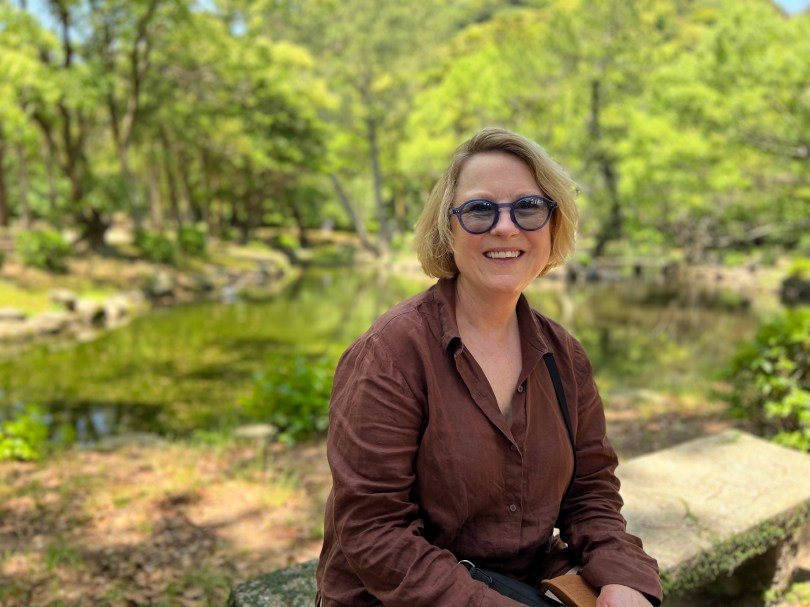
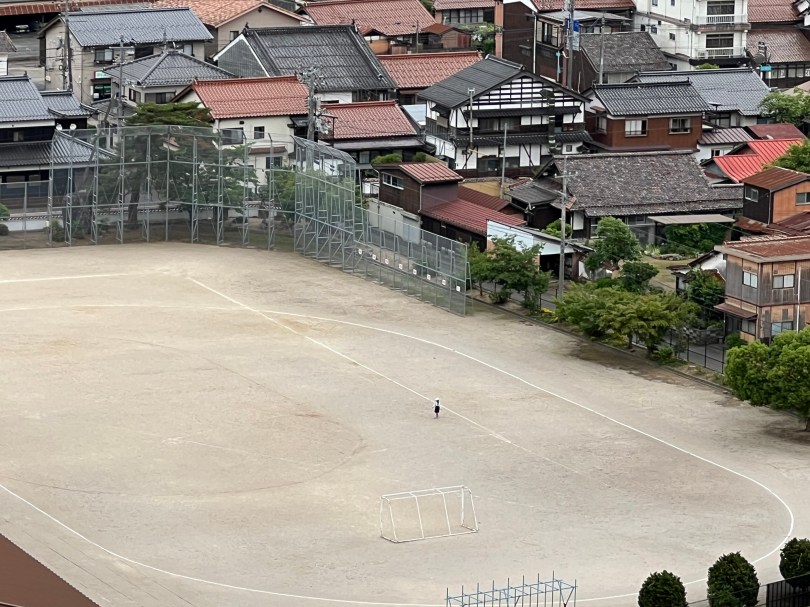
May 20 and 21, 2025—HAGI, JAPAN – We rolled into the historic town of Hagi after a longish drive from Shimonoseki, a short detour over the graceful Tsunoshima Bridge, and a side-trip inland to the Shuhodo Cave and the rocky, treeless Akiyoshi karst plain. We checked into a two-story apartment in a residential area, across the street from a school where a youth baseball team was having practice, the coaches hitting crisp ground balls to the fielders in the all-dirt diamond.
We walked to dinner at Hagi Samurai, a nine-seat counter restaurant that specializes in okonomiyaki, the savory Japanese pancakes loaded with seafood that Will likes so much. At the Hagi Samurai, the Hiroshima chef wears a traditional “samurai” topknot, or chon mage, where the center of his head is shaved and the dark hair on the sides is oiled and smooth. This description may make the restaurant and its chef sound more exciting than it actually was. In fact, the restaurant was strangely decorated in a mash-up samurai/baseball theme, the samurai guy was a bit strange, we shared the counter with only one other diner, and the okonomiyaki was laden with mayo and sort of mushy.
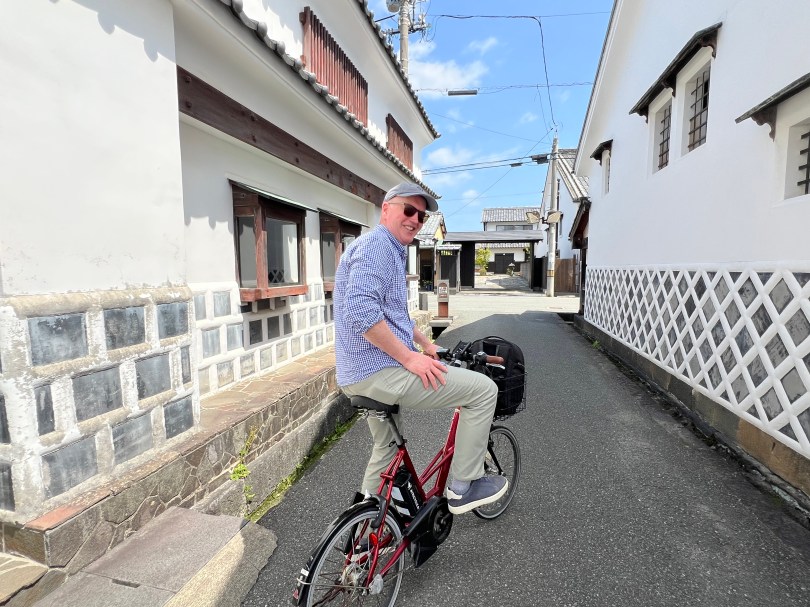
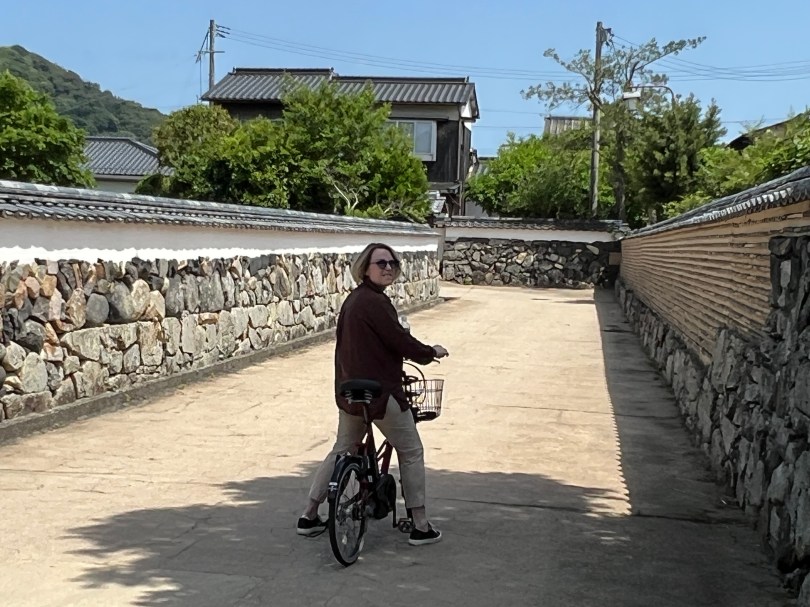
We woke up early the next day, as we have this entire trip, which was fortunate because it was by far the warmest and most humid day of our vacation. It was already pushing 80 by the time we had downloaded the apps and figured out how to rent electric bikes from the bikeshare, CogiCogi. Neither one of us had ever ridden electric bikes before, and there were no instructions, at least none in English.
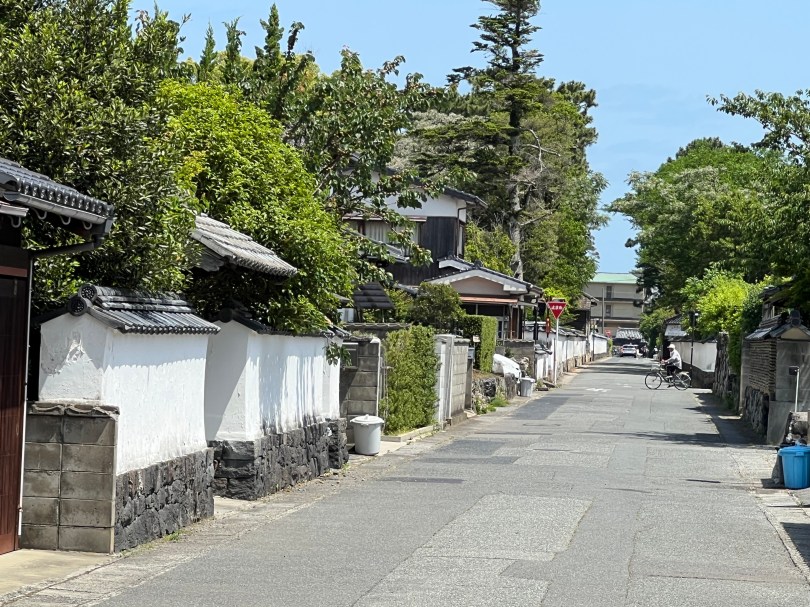
We started off at a brisk clip, although my bike had an annoying clanking sound. I was feeling pretty confident as we cruised into Hagi’s historic samurai neighborhood. It’s a surprisingly large samurai district, we are used to visiting towns with only a few blocks of historic buildings, but the thick walls and beautiful samurai houses in Hagi go on and on. The black tile and white plaster of the earthen walls was a symbol of prestige and wealth. These walls, with their distinctive crisscross pattern of tile and plaster, are called namako-kabe, or “sea-cucumber wall. Perhaps I was distracted by this remarkable history, and/or just clueless about electric bikes, but as I was following Courtenay around one sharp corner my CogiCogi bike suddenly accelerated with a thump into the back wall of one of the traditional samurai houses. There were no injuries, to rider or historic home. The good news is that it fixed the clanking sound on my bike.
To gather ourselves, we stopped for a Hagi pudding, and I had a cool, refreshing citrus flavor that the town is famous for.
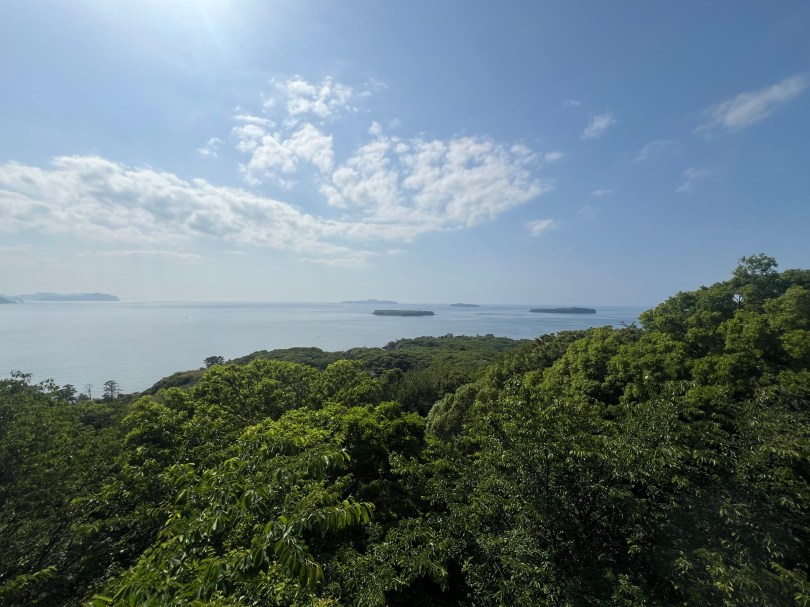
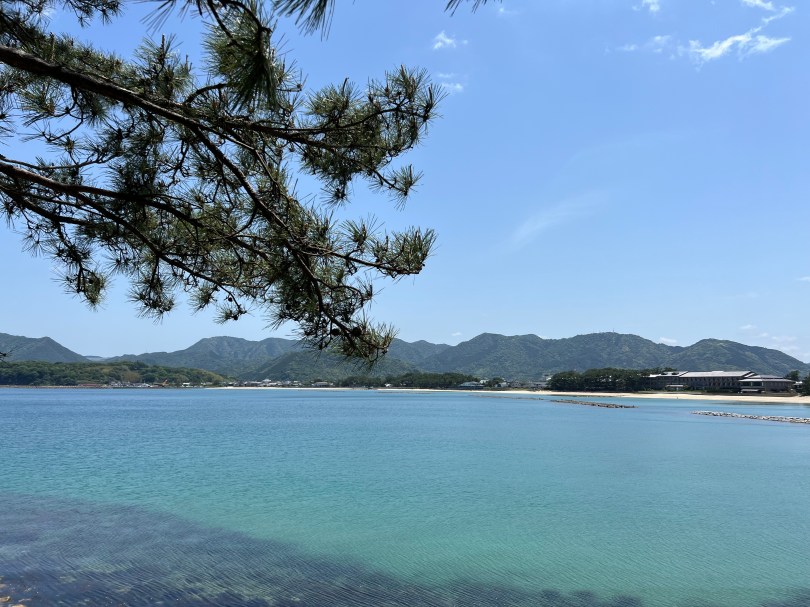
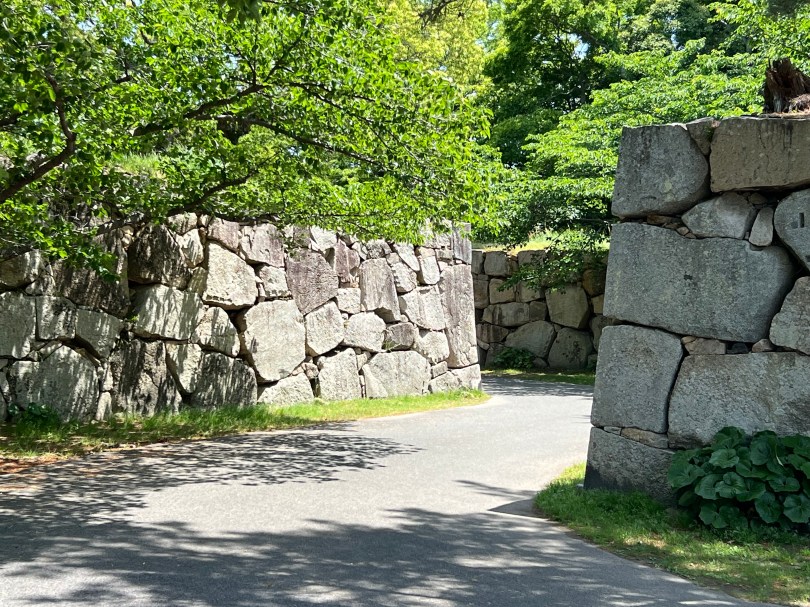
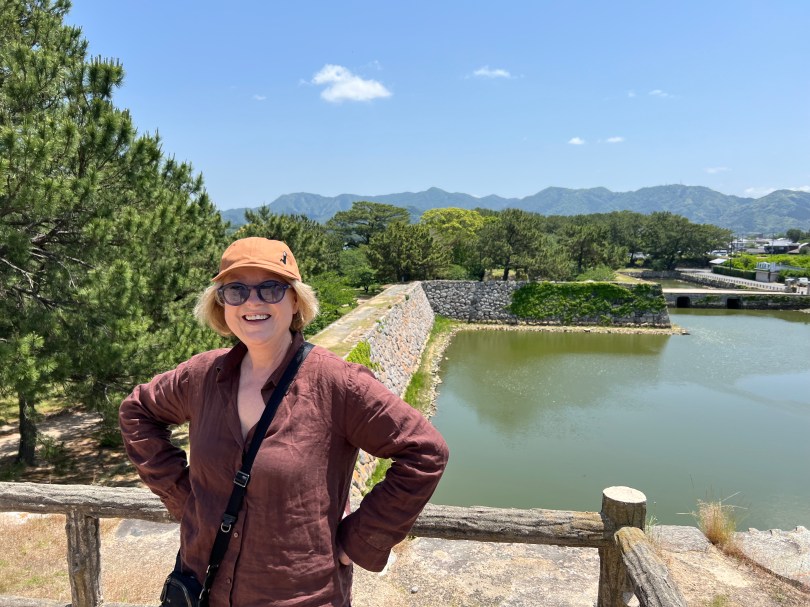
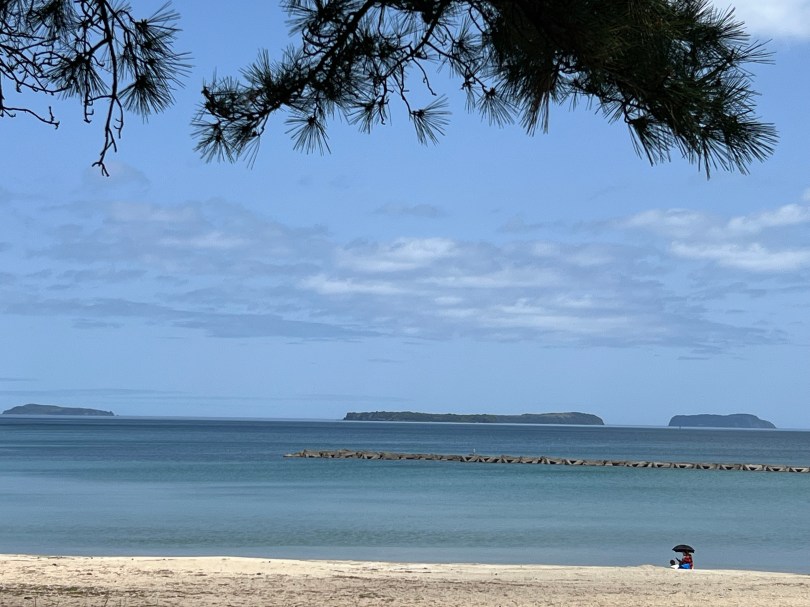
We rode on to the Hagi castle ruins, past a beautiful curved inland beach, where a few people were out and sunning at the water’s edge. There’s not much left of the Hagi castle ruins, just the stone foundation and low walls along the protective waterways. After lunch, where I had a Wagyu beef hamburger plate, it was so hot that we rode back to the apartment and exchanged the bikes for the rental car. We rode about twenty minutes to a well-known ceramics outlet, a cooperative where many artists display and sell their works. We bought a couple Hagi-style pieces, and on the way back, drove up Mount Kasayama for 360-degree views around Hagi and its coastline, which is dotted with islands.
We were really looking forward to dinner. Courtenay had found the restaurant on line. It was described as a tiny, hard-to-find place run by a couple in their 80s, who served omakase meals, which means the chef determines what is served each night. It sounded amazing. The restaurant was somewhat hard to find, but an old woman met us outside what looked like a garage and led us up a short flight of creaky stairs. There was a strong smell of cat urine. The restaurant has only four seats, with two of them set for us. We would be their only diners. It was quite possibly the oldest, most cluttered, perhaps least appetizing, place that we have ever eaten. However, the old couple was so welcoming, almost overwhelmingly so, and thrilled that Courtenay spoke and understood some Japanese. The old chef plied us with questions, wanting to know where we were from, why we were there, what we did for work, how long we had been married, while his shyer wife stayed in the background, preparing soup and taking away the chef’s used pans. I missed most of the conversation, but heard enough to understand that at one point the chef said I looked “like a movie star, but with a round, bald head.”
The chef got more and more animated, and eventually his wife joined in. He sat down next to me and began paging through a notebook filled with messages from foreigners who had come to Kokura, and had apparently fell for the same online descriptions that we had, with diners from Norway and Australia and Italy and Romania and many other countries. His wife helpfully noted that “No one in Hagi eats here.” The chef told us very excitedly that a “FBI SWAT team member” had visited, and he spent ten minutes fishing in his wife’s purse and looking around the cluttered kitchen before he found what he was searching for: a suspiciously fake looking “SWAT” badge that he proudly showed us. He was extremely excited after Courtenay told him that we were writers, and insisted that I write in his memory book. Like everyone else who had left a message in the book, I wrote how great his restaurant was, how much we had enjoyed the food, and what an unforgettable night we had experienced there. Some of that was true.
Somewhat surprisingly, we felt fine the next morning. Before leaving Hagi, we drove to the Aiba Waterway, a peaceful collection of homes constructed in the early 18th century for transporting rice and firewood. Fat and colorful Koi swam in the waterways around the beautiful houses, and we bought two tiny sake cups at a pottery store to bring home to remember our time in Hagi.
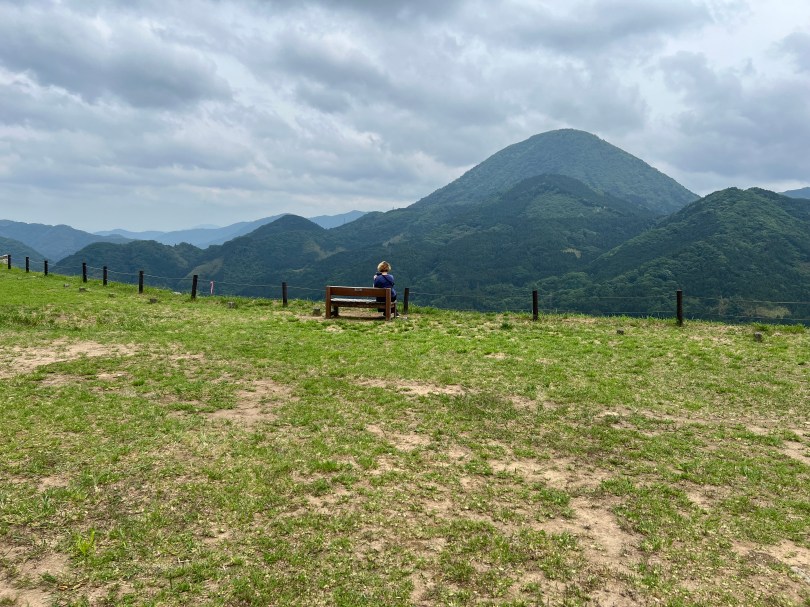
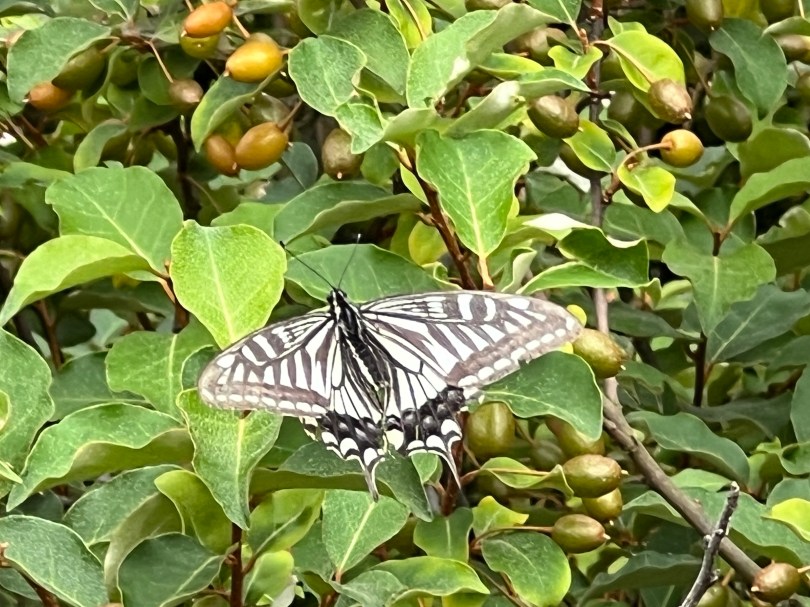
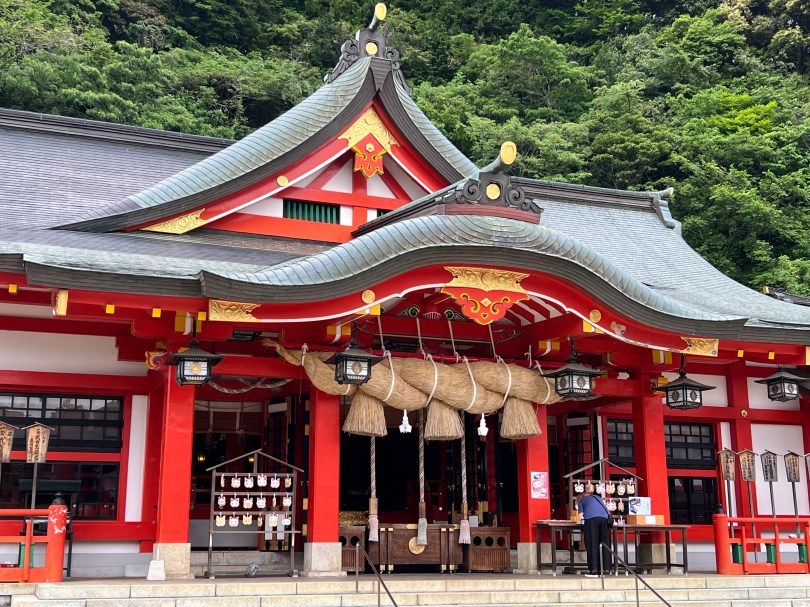
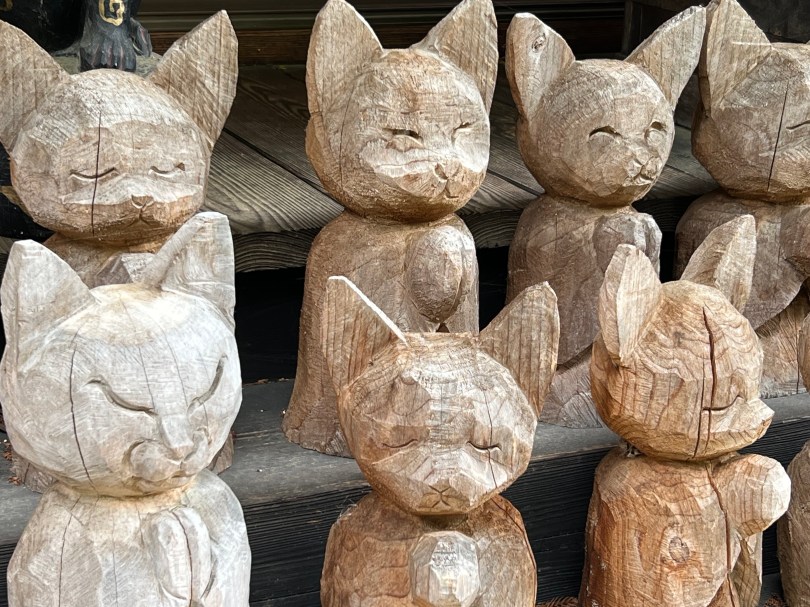
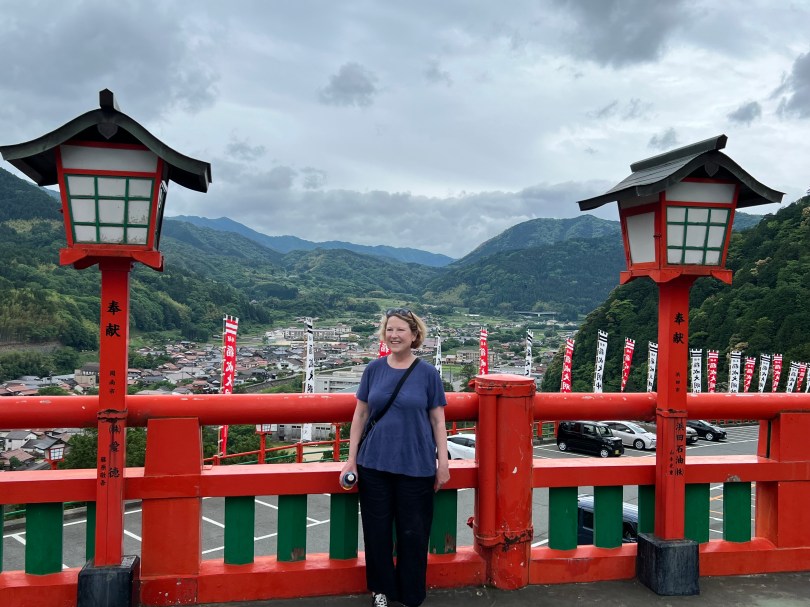
The Stunning Setting of the Fukutoku Inari Shrine
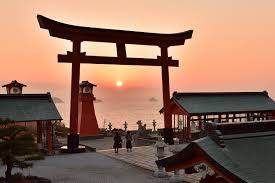
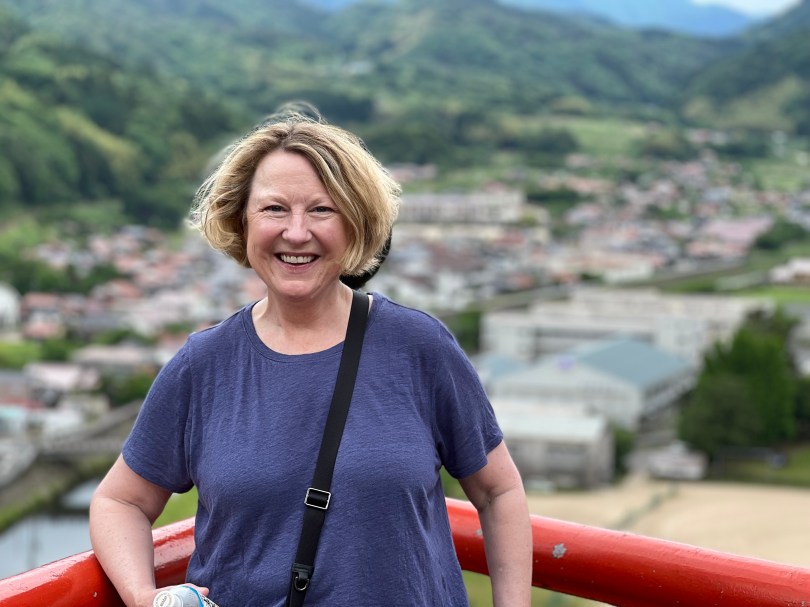
The first thing that must occur to almost everyone who arrives at the Fukutoku Inari Shrine, which sits high on a cliff overlooking the rippling blue-green waters of the Sea of Japan, is to reach for a camera or phone and start taking pictures.
Maybe that’s why photography is prohibited at the shrine.
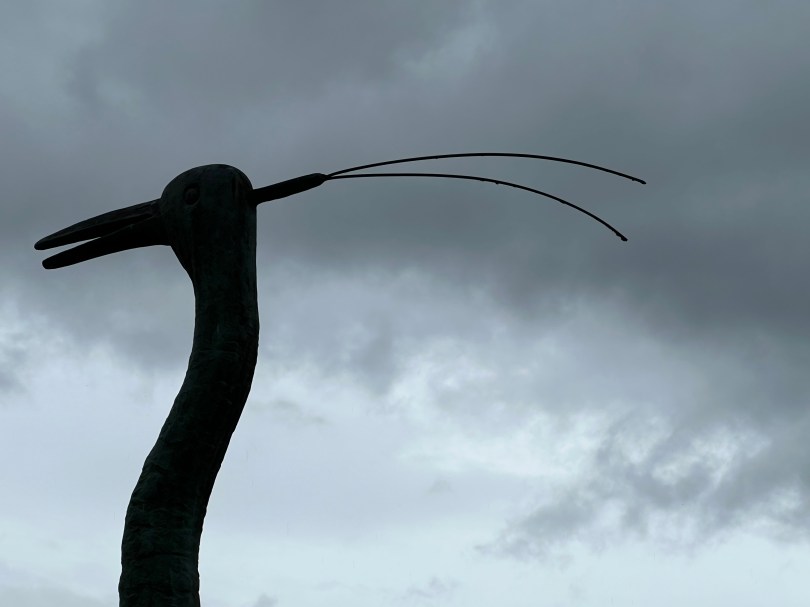
We obeyed the rules, which are posted in the parking lot and along all the walkways in and around one of the most beautiful shrines we have ever visited. The photos here were grabbed off the Internet. Apparently not everyone follows the rules.
The shrine is located in a remarkable setting, with a huge torii gate spanning the cliff overlooking the sea. It is distractingly beautiful, and perhaps the no-photos rule is meant to ensure that visitors don’t overlook the power and majesty of the shrine itself, or perhaps the faithful keepers of Fukutoku simply don’t want it overrun with influencers and Instagrammers.
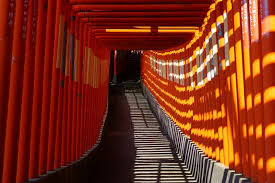
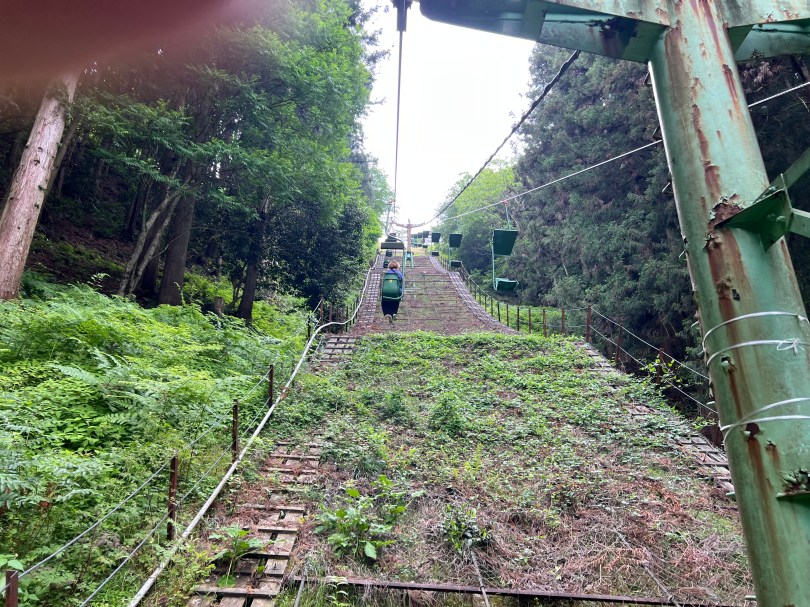
There’s also a 400-meter-long trail of smaller gates that snakes (more on this in a moment) down the cliff edge toward the sea. In the downhill direction, the route is marked by several signs warning of マムシ – Courtenay was like, “Ok, I know that word, what is that word? – oh yea, poisonous vipers!” With that exciting news, we kept closely to the path, our phones kept carefully tucked away lest of the watching Inari foxes spotted us trying to sneak a photo. On the return trip, up the steep hill, the signs encourage trekkers to keep going, keep fighting “Gambare!”
We appreciated the support.
The Wonders of Akiyoshido Cave


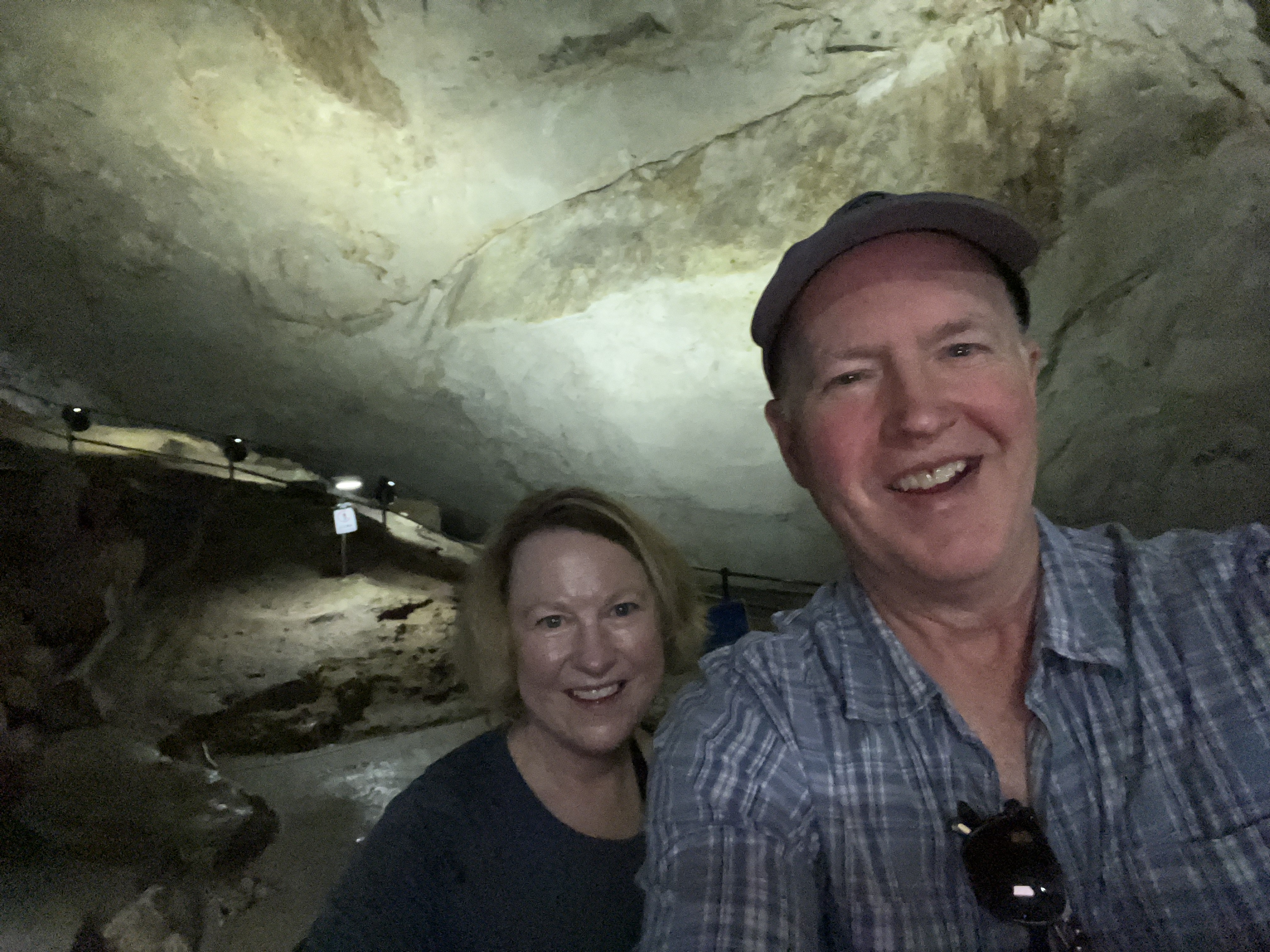

AKIYOSHIDO, Japan — May 19, 2025 — On a warm, muggy day, we welcomed the cool air and green, limestone-infused river gushing out of Akiyoshi Cave, the largest and most impressive limestone cavern in Asia. The cave cuts almost two kilometers into the rugged landscape of the Akiyoshi Plateau, a karst landscape created over 300 million years and now preserved as a Japanese national park but which looks more like something out of rural Ireland. The aging tourist facilities (charmingly Showa-era says Courtenay) and run-down retail strips around the massive cave disguise a really remarkable natural wonder.
Shimonoseki: Atmospheric and Downhill
SHIMONOSEKI, Japan — May 18, 2025 — We spent today exploring this deeply historic city on the edge of the Kanmon Strait, which over the centuries has been the site of some of Japan’s most legendary naval battles, and now is busy with shipping and fishing vessels.
It was a beautiful Sunday, and it seemed like everyone in the city — multigenerational families, young couples pushing strollers, packs of teenagers — were relaxing and picnicking along the waterfront. We started our day among the cannons and statues lining Mimosusogawa Park, the narrow pinch point in the Kanmon Strait, and where many fierce naval battles and bombardments have taken place over the years, including the famous 12th century battle that launched the age of samurai rule. (Our hotel room looked out on two island where the victors, under Minamoto warrior Yoshitsune, hid before defeating the Heike and their child-emperor.)
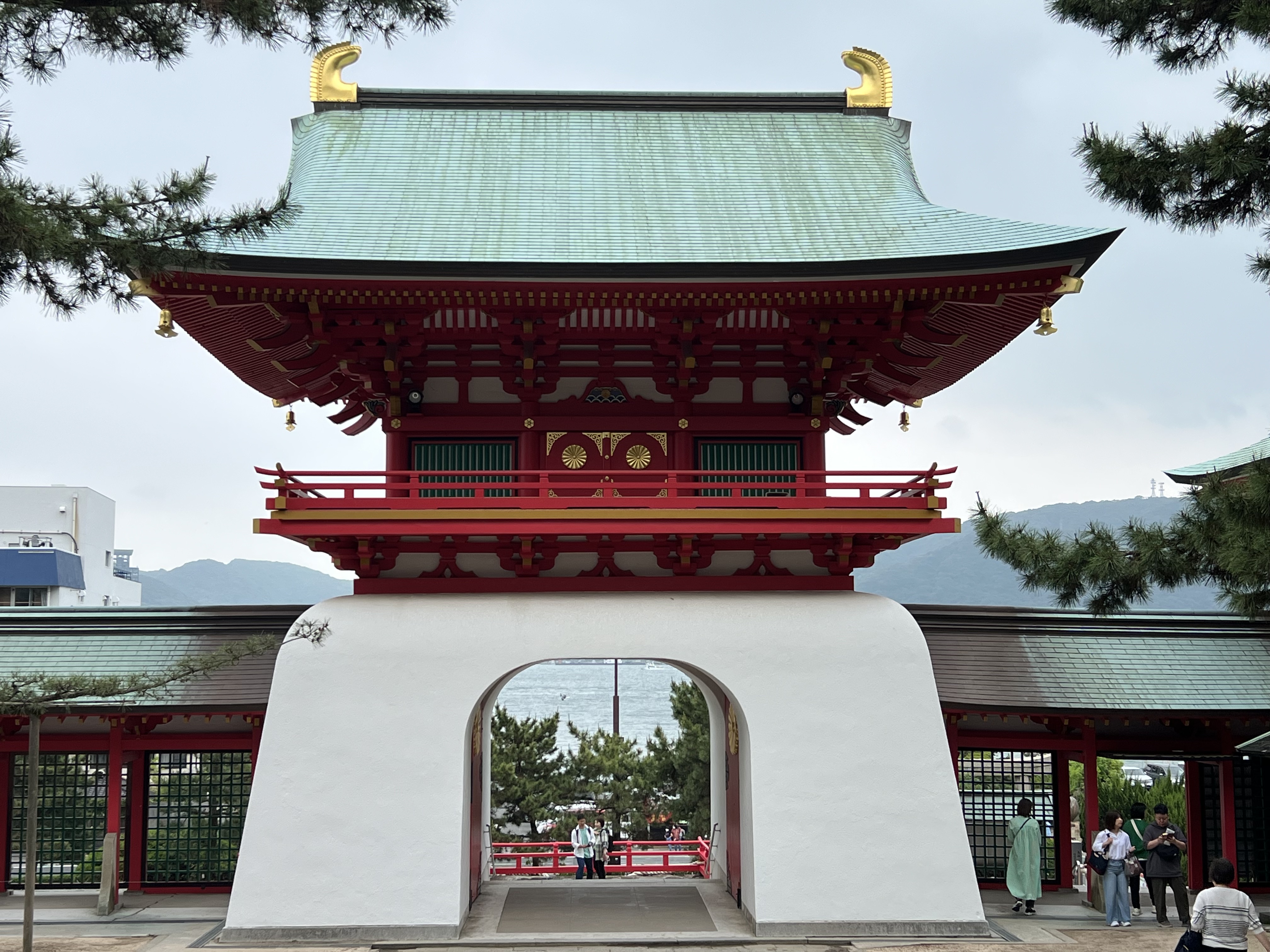
We walked on to Akama-Jingu, a shrine dedicated to a child emperor who was killed in the battle of Dannoura, in the churning strait, along with his grandmother, who saw how the battle was turning and jumped into the sea to perish with him. The story of the Heike became one of the epics of Japanese literature, its stories reverberating down the centuries. As we climbed the steps to Akama-Jingu, we came upon a wedding party posing for pictures, the blue-green waters of the Kanmon in front of the them, the bright red-orange shrine behind. We also saw the small and moving shrine to a blind Biwa-player named Houichi, who legend says lost his ears to the ghosts of the Heike.
From there, we strolled through a Sunday outdoor arts and crafts tent market, a nice scene with music and kids running all over the place, and past the Karato Seafood Market, which seemed like the epicenter of Shimonoseki life, absolutely jammed with locals. We weren’t hungry yet, but we would return later to pick up fresh sushi and join the people sitting and eating along the strait.
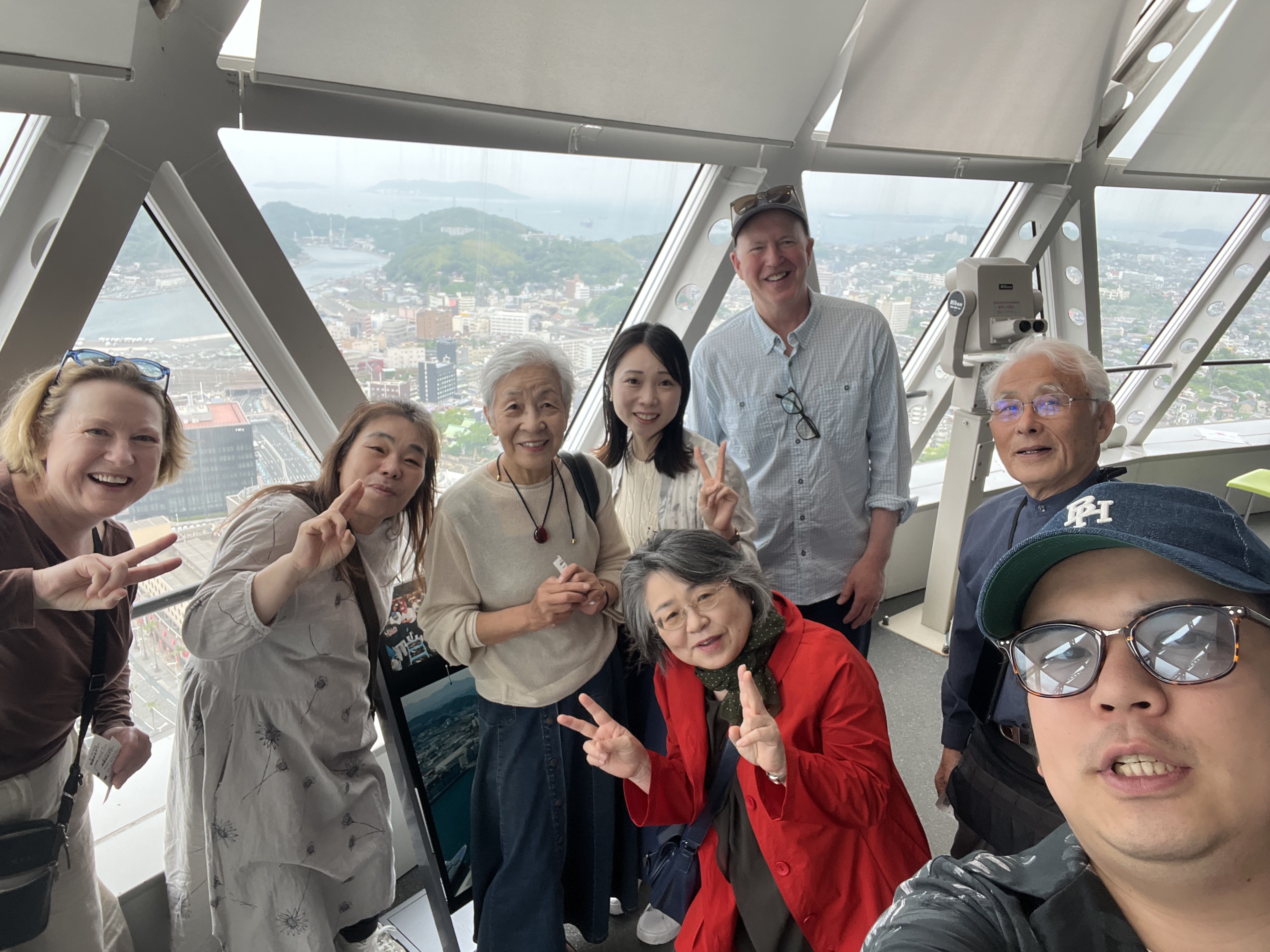
We went from the fish market to the Kaikyo-yume Tower, a 30-story-high observation tower that rises over Shimonoseki and offers a bird’s-eye view of the city, the islands and rugged nearby mountains, and the Sea of Japan in the distance. We wanted to take a bus to the tower, but were unsure about the routes and bus numbers. Courtenay asked some waiting passengers for advice, and it turned out that they, too, were headed for the tower, and that quick, we had new friends and travel partners. They were three generations of family, there to spend the weekend together. They were so friendly and welcoming, full of questions about us, and they guided us onto the bus and up to the tower, eager to show and tell us about Shimonoseki. The patriarch, who had attended twice-weekly English lessons for years, had spent his life here, and worked in construction management; he proudly told us that his company had been involved in inspecting the very tower that we were ascending. It was great fun, meeting and talking and posing for pictures with them. As we parted, they offered us gifts of fugu-themed rice crackers. (Everything is fugu-themed here – fugu, or the potentially poisonous puffer fish – is the local mascot and appears on everything from mail boxes to sewer covers. It also makes for a mean sashimi – just make sure you don’t try it at home – it has to be prepared by someone who knows what they are doing to avoid fatal consequences. BTW, we survived.)
We spent the afternoon in Shimonoseki’s Chofu Castle Town District, which is studded with shrines, abandoned temples, and samurai-era streets lined with stone walls and beautifully preserved homes. We started at the Iminomiya Shrine, where Courtenay had read might be celebrating a rabbit-themed spring festival today, which sounded like it might be a sweet scene. However, it turned out that the shrine was holding nothing more than a flea market, and a bit of a shabby one at that. (Courtenay thinks Rick is being overly harsh here, given the depth of his disappointment over the rabbits. It was just a regular flea market with dial-up phones, old clothes, some crafts.)

If the rabbit festival was a bust, the rest of Chofu Castle Town was actually quite cool. We wandered through the Chofu Mori Residence, a stunning house where the Emperor Meiji once stayed. We also walked up into the Kozanji Temple, one of the oldest temples constructed in the Zen-style in Japan and a designated national treasurer. I was wearing down after so much walking, but we came up on the Dangu Kawa River, more of a creek, I would say, where the town and its residents have restored the waterway and been trying to bring back the fireflies that were once common there. Courtenay asked me if I wanted to keep walking, and I said, sure, since the street we were on was “atmospheric and downhill,” which struck her as funny, and has since become something of a catchphrase on this trip.
We walked from the castle district on to the Chofu Garden, where we stopped to get our entry tickets and found the attendant absolutely sound asleep, and had to wake her to get our tickets. The garden, as you might expect, was quite peaceful. It was beautiful walking around a koi-filled pond while we heard the sounds of a pipe-player putting on a concert in a nearby building.
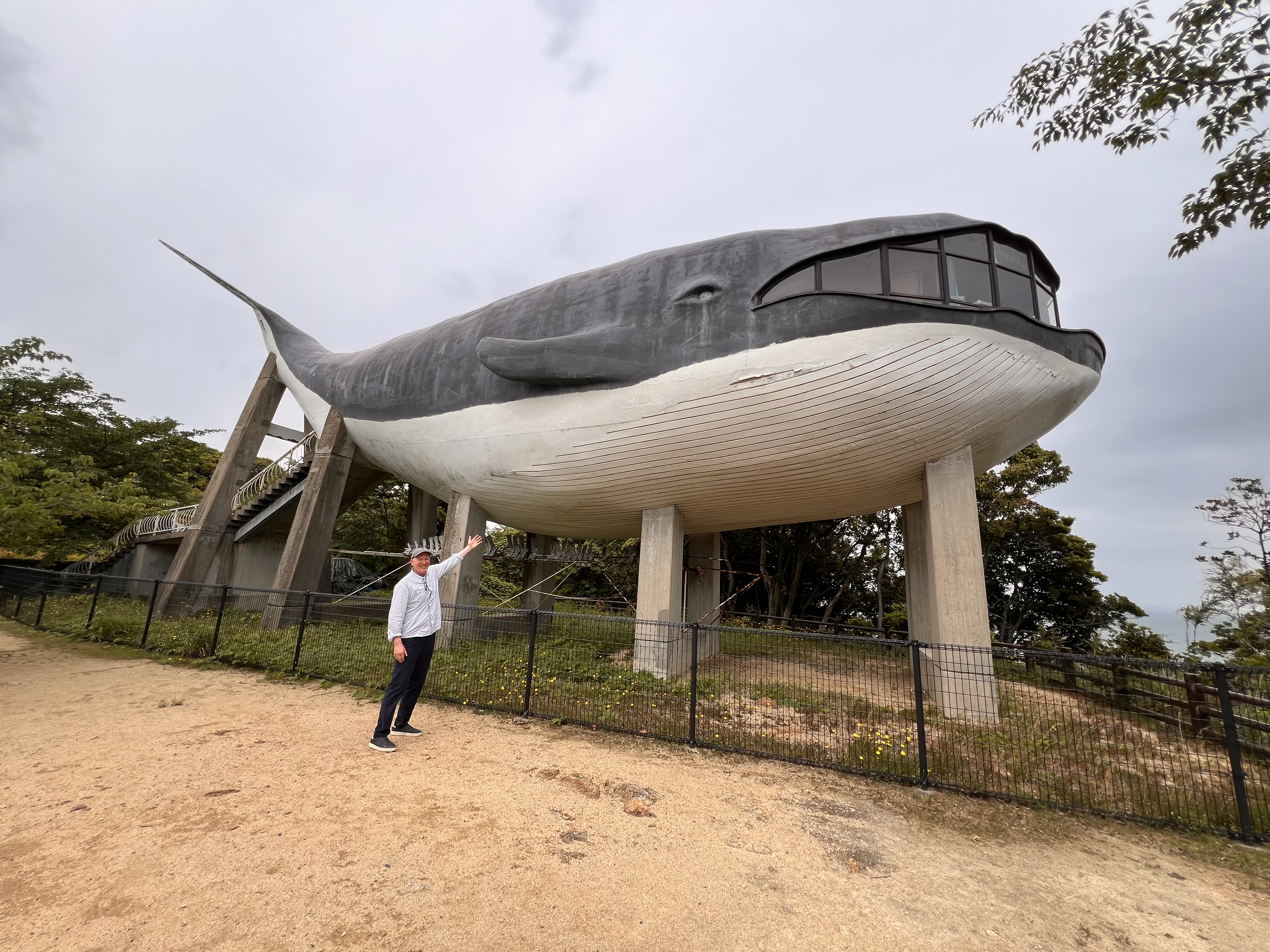
We finished our walk by climbing up to the ruins of the old Shimonoseki castle that overlooked our hotel. All that was left of the small castle that had once been here were some walls – the rest destroyed in the early 17century at the orders of the first Shogun Tokugawa Ieyasu, who wanted to limit the power of his provincial rivals. In fact, this part of the country is known for its independent, rebellious streak, resistant to control from the center. While Courtenay enjoyed the ruins, Rick was absolutely delighted by a giant decaying model of a great blue whale that once stood near the Shimonoseki Aquarium. The whale had seen better days and the aquarium apparently wanted to get rid of it, and so it dropped it on the hill by the ruined castle. I loved the whale; it reminded me of the cheesy Paul Bunyan and Babe the Blue Ox models at the Trees of Mystery, in Southern Oregon. — Rick
Sumo and the Six-Minute Shinkansen Transfer
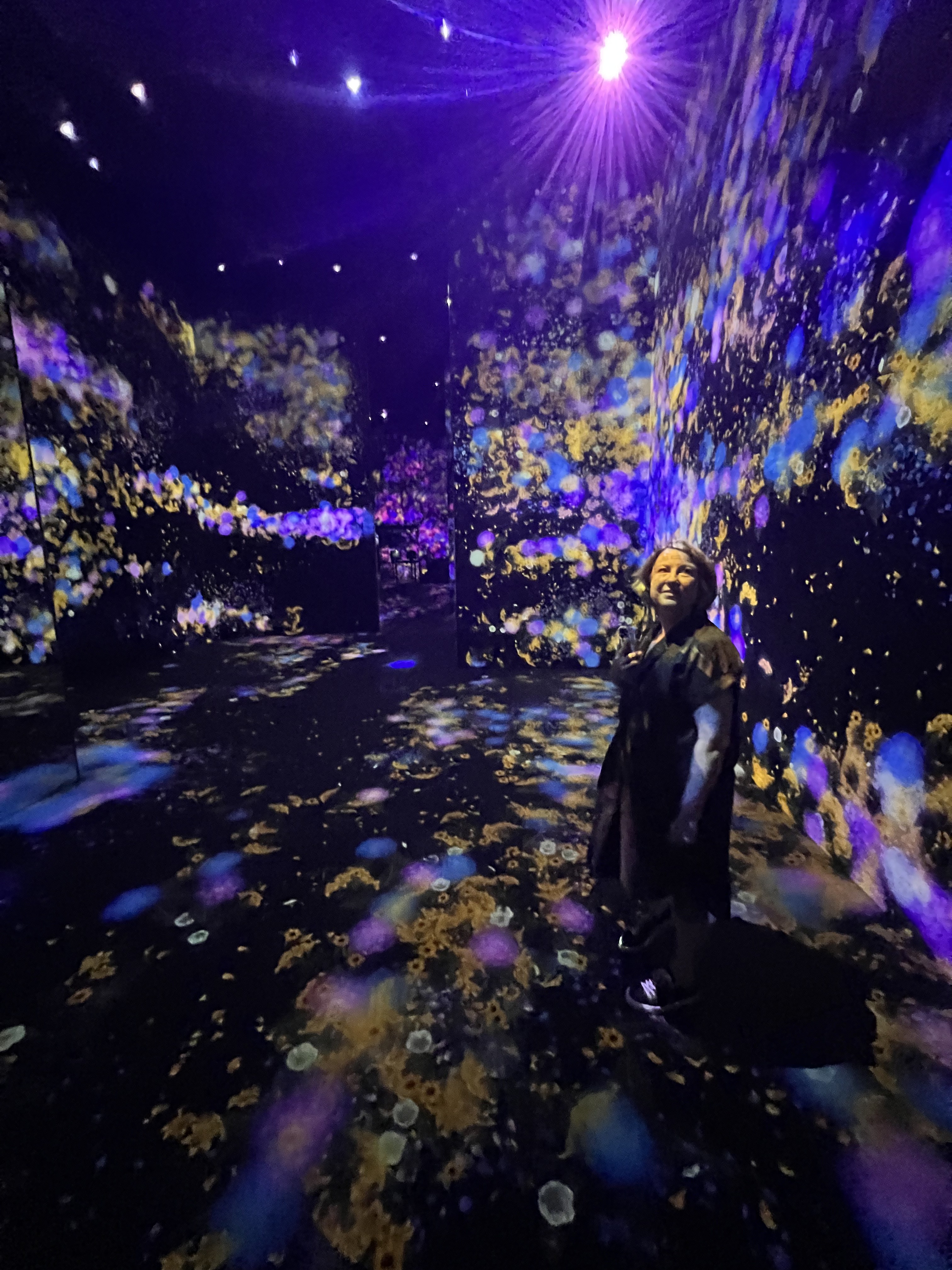
ON THE SHINKANSEN, Southern Honshu, Saturday, May 17, 2025 – Our time in Tokyo went by as fast as, well, as fast as the 300-kilometer-an-hour bullet train hurtling us southward right now. We had a long, busy day yesterday, starting with the teamLab Borderless digital art museum/experience at Azabu-dai. It was classic teamLab – digital art projected on walls, ceilings and floors, or from strings of crystals or sparkling globes, hanging from the ceiling, surrounded by mirrors. The installations give you a feeling an infinity, like Kusama Yayoi’s famous pieces. We saw the same tigers made up of moving masses of flowers, and hauntingly weird rabbits and other frog-like creatures we had seen projected on the stone castle walls at Kanazawa back in 2023. (It was much more beautiful, and interesting, projected on atmospheric castle walls – don’t miss it if you ever have a chance.) Our highlight experience was probably the room that had children’s drawings of fish and other sea creatures swirling around the walls and ceilings of one room – we finally figured out we too could make drawings to be projected on the walls. So I made a “Hazel Fish,” and Poppa made a “Rory Fish.” Soon, Rory and Hazel were swimming happily around the room with the other fantastical creatures.
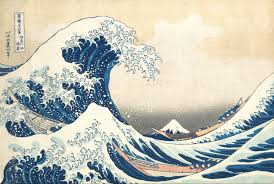
From there, we headed over to the other side of the Sumida River, where we visited a new and interesting museum dedicated to the woodblock print art of Hokusai, most famous for his series of prints “36 Views of Mount Fuji,” including his most famous “The Great Wave Off Kanagawa.” The Sumida Hokusai Museum, which became quite crowded, had excellent displays on how the blocks were drawn, carved, and printed in many layers. These woodblock prints had a big influence on the art of late 19th century France, including the Impressionists – Monet, Manet etc. – as well as Vincent Van Gogh, who collected them whenever he could find them.
After that, we stopped at a famous soba shop, Hosokawa, where the owner makes the buckwheat noodles by hand every morning. We had heard the lines can be long, so we went early, and immediately got a table with several groups of older Japanese women – two had been shopping and one elderly woman was enjoying her noodles all alone – they were that good. It will be interesting to compare them to the soba we have along the southwestern edge of Honshu, which is also famous for its pure buckwheat noodles. We love soba so seek it out whenever we are in Japan.

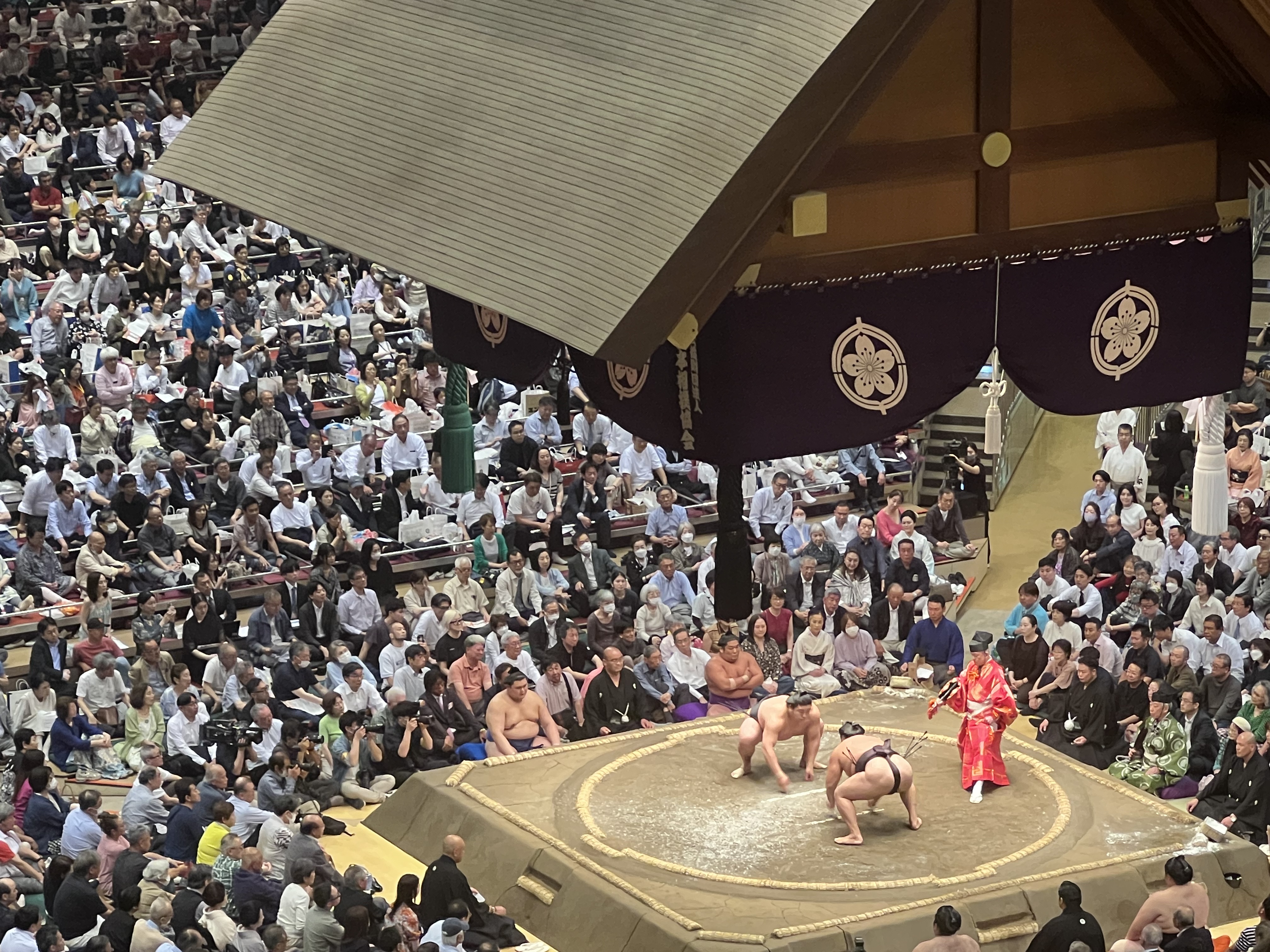
Our last stop was the Ryogoku Kokugikan, or the national sumo arena, a short walk away. It was only 1 p.m. and the main sumo didn’t start for two and a half hours, but we didn’t dare take a cab back to the hotel – the worst thing to do when you are jet lagged is stop moving. So we watched some of the rikishi, or sumo wrestlers, walk into the stadium in their yukata robes and flip-flops. We then took our seats, which were very far from the center arena, or dohyo, in a section that was filled with gaijin, as we foreigners are called here. All of those in our row had gone through the same hours-long process of trying to get tickets the second they went on sale. The website kept crashing, but those of us in row 9 had persevered and finally managed to secure tickets. I joked that the website had identified all the IP addresses outside Japan and stuck us all in the same section, but it was fine. Even the lovely Canadian couple sitting next to us were very sweet and didn’t mention anything about, um, things back home.
I had spent some time reading about the wrestlers – who is on their way up, who is on his way out – and had some fun details about which wrestler had a tiny toy poodle and loved gardening, and which was the bad boy who got caught at hostess bars during the pandemic, and. which was the eponymous “Flying Monkey.” In any case, we have followed sumo over the years, first when I was in Japan as an exchange student in college and then when Will was little and we would watch together in the evenings on one epic trip to Japan. So it was really wonderful to finally see it in person. My friend Hope had said it’s best to sit on the floor in reserved seating where she had gone as a child growing up in Japan, but we didn’t even try for those seats – we couldn’t imagine sitting on the floor for four to five hours straight without perhaps losing feeling in our legs and our legs altogether. So we sat in the nose-bleed seats and were really able to see all the action just fine. It was just too far to clearly see the rikishi’s facial expression or really feel the intensity of the wresting or the size of the wrestlers themselves, a few of whom are up to 6-foot-5 and/or 420 pounds. But to see the rituals and camaraderie of the sport which dates back centuries and is steeped in Shinto spiritual practices was really, well, awesome.

As you perhaps know, I am a cautious traveler who arrives at the airport two hours early and never books an airline transfer under 90 minutes, so I was a bit worried about a six-minute transfer from one Shinkansen to another today in Hiroshima. Six minutes? I mean, in the US, that would be insane for practically any transfer. But I trusted that the Shinkansen website would not lead me astray, and it turns out that six minutes is a loooong time for a transfer in Hiroshima. We just walked across the platform, and after a very long four-minute wait, there came our train – a sleek, pink Hello-Kitty themed train that everyone had their phones to capture its adorableness. So now we are speeding south on that pink cat-covered Shinkansen – which is also awesome. Rory and Hazel would love it. My mother would love it. I love it. I’m so happy to be back in Japan!





 The Thompson Attigs